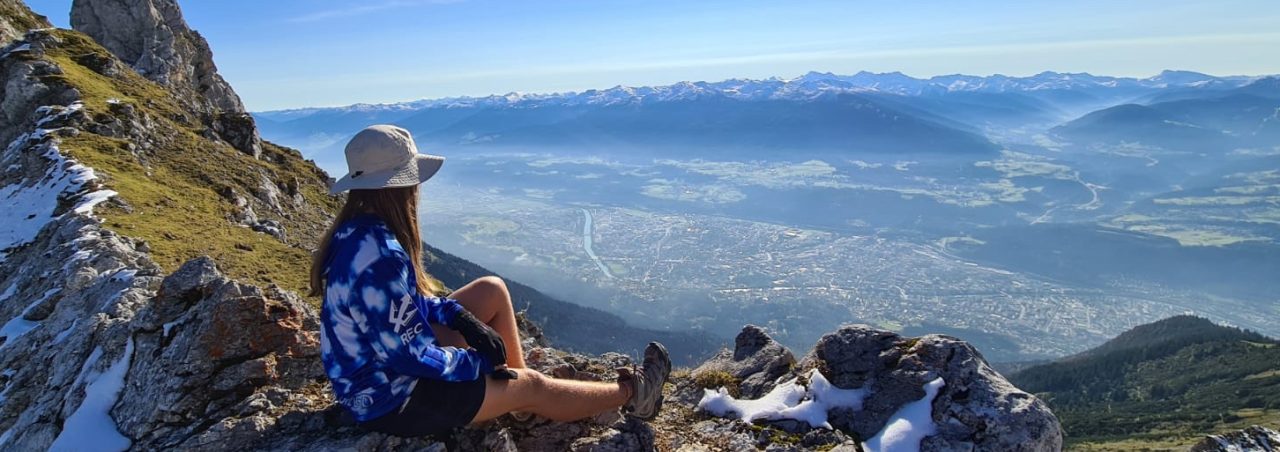
My New Life in Spain

My feelings towards my new life as an English teacher in Spain change drastically from moment to moment. At times, I think… Wow. This is amazing. This is such an awesome opportunity to live and work abroad and experience a new culture. I’m so lucky. I have thoughts like this after a great class at school, or while exploring a new city.

Then there are other moments when I feel so lost… Amber, you’re ridiculous. Why do you keep moving to countries where you barely know the language?

I was stuck in this thought cycle last weekend at a salsa dancing club in Valencia. It was a combination of two new life challenges: speaking Spanish and my identity as a dancer. My thoughts were battling my experience, and I couldn’t help but think, You’re an athlete, not a dancer. And the noise from the club made it impossible for me to understand what the sweaty men were saying, even if they were speaking English.

These moments when I feel completely and utterly lost because of the language barrier remind me of my two years in Japan. From 2014 to 2016 I lived in Fukui Prefecture as an Assistant Language Teacher with the JET (Japan Exchange and Teaching) Program, and I also went into that experience knowing zero Japanese. (Am I brave or am I stupid? is a question I ask myself…) 

After leaving Japan, I only had two months of transition time at home in California, and then I traveled with my dad in France and Switzerland for three weeks doing via ferratas, and now I’m completely immersed in Spain. The food, the language, the culture, the history, people’s attitudes, the daily schedule, my role at school… so much is drastically different!

The newness can be overwhelming at times, but luckily I’ve found a comfortable apartment where I can decompress. I live on the liveliest street in a town called Almendralejo, population 34,000, with three flatmates. I have my own room but I share the living room and kitchen with two Spanish university students, Carmen and Fede, and another English teacher named Margrit from New York. We have a balcony overlooking a big plaza boasting three restaurants and a playground, which is often filled with kids buzzing around on scooters. I can walk to a bar or a grocery store in 2 minutes, and rent is ridiculously cheap.

I teach at two schools. One is a private Jesuit high school and elementary school in a pueblo of 2,800 people called Villafranca, which is about a 15 minute drive from my apartment. I catch a ride to school with a young teacher who wants to improve her English, so we alternate speaking English and Spanish. We’ve become friends, and  she’s invited me to go salsa dancing with her a few times.

The other is a public high school in a town of 3,700 called Hornachos which is nestled below a small mountain range. The weaving road to Hornachos, next to red flat lands and speckled with olive trees, reminds me of Australia. I pass the 30 minute ride to school by practicing my Spanish with my generous coworkers who give me lifts.

My work life is satisfying and challenging. When I first arrived here I told my supervisors that I had two years of teaching experience, and that I really wanted to take an active role in teaching. So in my 12 classroom teaching hours, I’m completely responsible for planning and teaching 8 of those on my own. After studying the material given to me by the main teachers, I design a lesson filled with interactive presentations, songs, games, role-play, debates, or whatever I can think of. I’m really grateful for the chance to use my creativity! 

At the elementary school, I’m teaching social science to 3 classes of rambunctious eight, nine, and ten-year-olds. The textbook features topics like “The Water Cycle” and “The Geosphere,” and it’s a great challenge for me to make these subjects accessible for them.

I use some techniques I learned in Japan, such as walking around and checking their pronunciation individually (with many smiles and high-fives!) I’ve learned quite a few classroom games for teaching vocabulary, and I’m always learning more. 

I’m picking up quite a few classroom management ideas, too. I use a call and response rhythm game or a countdown to get their attention when they become noisy.

In my free time, I go to the gym, dance zumba, cook vegan food, study Spanish, or hang out with my roommates. I travel at least once a month. So far I’ve been to Madrid, Caceres, Badajoz, Seville, Salamanca, and Valencia on weekends, and I have a long list of places I want to go!

Although it was a difficult decision, I decided to stay in Spain for my winter holidays. I will be volunteering at a youth hostel in a small pueblo outside of Granada. I hope that my experience there will be up to par to what I did last winter vacation!

Last Christmas I volunteered on an oyster farm in Kumihama Bay, Japan, where I learned all about the process of farming oysters, and got experience life as a farmer for a week. In the village I only met two people who spoke English: Atsushi, the generous man who coordinated my stay, and Goshia, another volunteer from Poland who became a very good friend. Even though it was cold, my week volunteering there tops my list of experiences in Japan.

I love living somewhere new and learning how everything works! Atsushi told me that when he lived in Canada, his mind expanded 100 times, and I can completely relate. Every time I live in a new place, I can feel my brain growing… there are so many possibilities for this life!


Scaling Cliffs in Switzerland and France

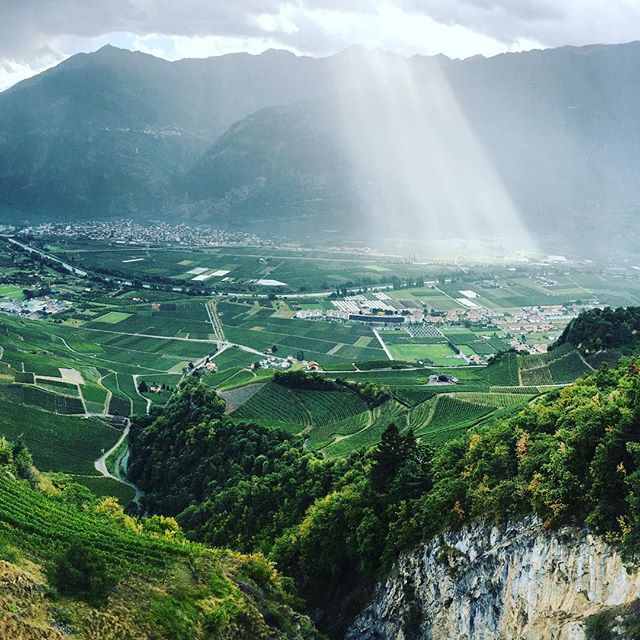
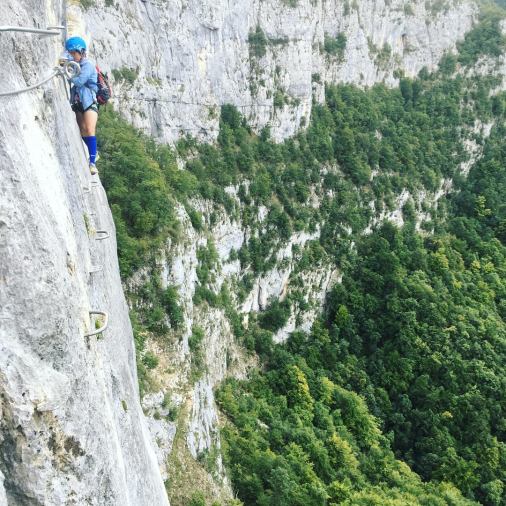
Imagine yourself on a cliff, your harness tied into a metal cable via 2 carabiners and straps, standing on metal rungs looking straight down 800 feet. You are above an expansive green valley high in the Haute Savoie region of the French Alps, south of Geneva.  An hour ago, it was raining, but the sky has cleared, and rays of light filter through the clouds like a message from God.

21826964_1554674664571517_4051691170009448448_n

This is the view you see. Your heart is beating quickly, yet you are safe. Does this sound terrifying to you? Would you try it anyway?

In Italian, Via Ferrata translates to “the Iron Way.” The origins date back to the First World War, where some Via Ferratas were built in Italy to help troops cross over the Dolomites efficiently. Now, they are the perfect excursion for thrill-seekers, and make epic cliffs more accessible to adventurers of all ages and levels of athleticism.

I got the chance to try 17 via ferratas this summer with my dad in the Swiss Alps and in the Haute Savoie region of the French Alps, north and south of Geneva. We zoomed through valleys and up tiny winding mountain roads in a rental car, following advice from “Via Ferratas of the French Alps” by Richard Miller. Our original goal was to to cram as many vias as we could into our two weeks together.  Later our goal changed just to do the highest rated vias. Since my uncle Jimmy had been climbing with Dad a few weeks prior, he graciously left me his harness and carabiners, so all I had to do was buy a helmet and gloves and we were ready to go.
 The guidebook we were using rates vias from 1-5 and with three factors: difficulty, exposure, and accessibility, A, B, or C. Difficulty is how physically challenging it is, exposure is how high off the ground it is, and accessibility is how long it takes to walk to the start. Dad first wanted to check I was capable of managing the equipment, so we started with some easier routes. The first few we did in the Savoie region were a 2,2, A called St. Sorlin d’Arves and a 3,3, A at St. Colomban des Villards, Savoie. These required a low level of athleticism, and we saw kids doing them too.

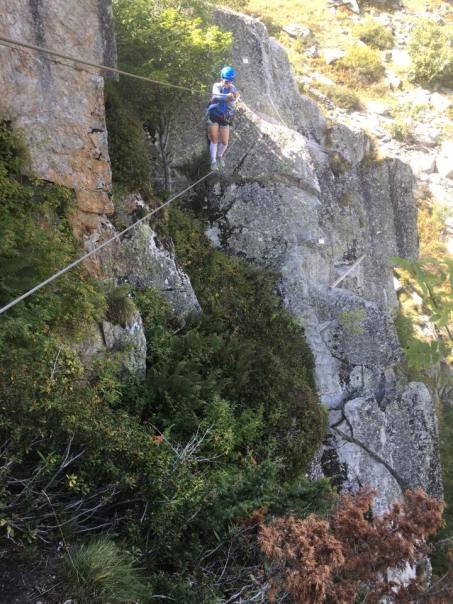
Once I realized that I could easily do a 3-3, I tried to convince Dad to let me try a 5-5. He finally conceded at Les Rois Mages, Assois, France. The scariest part of that route is a single-line bridge, with only one shaky wire to walk on and one to hold on to, and a huge drop-off beneath you that you are forced to look down at as you sidestep across. (We always wondered how we would get back off if we fell off that part. I think I would go about it like a koala.) After that route, I felt the true draw of via ferratas: a combination of fear and exhilaration, and at the end a huge sense of relief mixed with accomplishment and achievement.

21433236_10155134241043768_5009459834346114100_n
This was one of the scariest moments of my life.
This was my dad’s second summer of doing Via Ferratas in a rental car ($13 per day from the Geneva airport on the French side). He discovered them in 2010 when his friend Anne Claude took him on one in Engleberg, Switzerland.

“I kept thinking, ‘the Swiss are crazy,’ as I was climbing,” my dad told me. “But then here I was on a cliff with incredible views feeling safe. I was hooked.”

He bought the harness, helmet, and two via ferrata straps and caribeeners, and spent the summer driving around Switzerland in a rental car.

Getting to the via ferrata was often an adventure in itself. Many vias require a hike in, and sometimes it’s tricky to find the trail.  On Via Ferrata des Orres (5,5,B) in Crolles, France, we almost gave up after a 5 mile hike and bush walking next to the cliff face, but then I backtracked and realized we had missed the unmarked trail leading to the start.

21688081_10211982815779868_2688606574448869205_o

One of my favorite vias we did was Crotte a Carret (5,5,A) in France. After a 2 mile downhill hike, we reached the cave where it started. In the 1800’s, Jean Carret built a little dwelling in the cliffside next to this cave so he could do prehistoric digs.  Now one of the hardest vias in the world starts from inside it.

Another highlight was the via out of St. Hilaire du touvet, near Crolles, France. This via was a 5,5,A, with many laybacks and small holds. It was raining that day, so we weren’t sure if we would be able to do it. But we decided to hike to the start and see if the weather would take mercy on us. Luckily, the sky cleared just at the right time, so we were able to do the climb. I saw paragliders swooping by us along the way, as well as a mountain goat leaping down the cliff.​

Along the way, we stayed at youth hostels and cheap hotels. As I try to follow a mostly vegan diet I was mostly buying my food at grocery stores and preparing my meals on the go. We snacked a lot on trail mix and fruit in between vias. I enjoyed cooking for my dad in our hotel room.

When I’m doing a via, I forget how high up I am. Just like anything, it’s an exercise in mindfulness and being present. I’d try to unite my movements and my breath, and observe the climb before starting each section, planning my movements ahead of time. When seen in sections, a huge overtaking becomes a set of steps. This way of thinking reminds me of the main point of one of my Japanese students speeches: “Set small goals that you can reach!”

My dad and I talk about flow, which is the feeling you get when everything else seems to slip away, and all that’s left is you and the rock. You’re not worried about anything else, but completely and totally in the present moment, one with your breath and your motions. On vias, especially on difficult ones, I could feel my reality dissipate, all my to-do lists and worries about the future melt into nothingness, as I just focused on ascending the cliff I was dangling from. It’s a rare feeling, but I want to cultivate it in my every day life. I’ve had these moments fleetingly in yoga and meditation, or other sports like ultimate frisbee. All that matters is the task at hand.

Next summer, my dad will return to Europe to do more via ferratas in the Italian Dolomites, and I hope to join him! I’m so blessed to have an active and adventurous father, and I want to take advantage of these summers we have together to do something epic. Does anyone want to join us?

Santa Barbara Summer

IMG_4548

This summer has been a whirlwind. After closing my life out in Japan – a long process which involved deep-cleaning my apartment, closing out my bank account and transferring money home, cancelling my local phone number, selling my car, bike and electric piano, saying goodbye to all my friends, students, and co-workers – I finally went home.

On July 26 I took two trains, a plane, and a bus from Fukui, Japan to Santa Barbara, California.


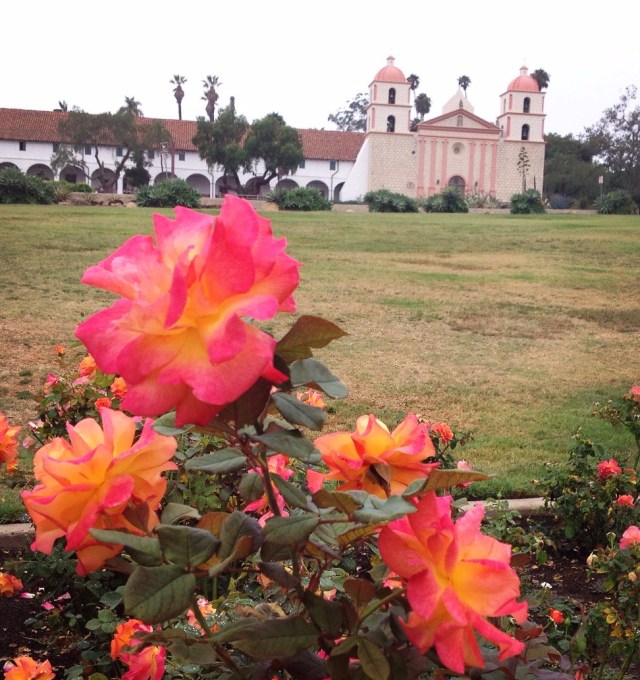
I was there for ten weeks, giving me ample time to reunite with family and friends and even do a bit of traveling.  I made sure to bask in Santa Barbara’s natural beauty, too. I spent many morning jogging and doing yoga on the beach.  On Wednesday evenings and Saturday afternoons, I played ultimate frisbee at East Beach and jumped in the ocean afterwards.

It’s amazing to see what everyone has been doing during the past few years. Several friends are pumping out their PhD’s – Natalie at University of California, Santa Barbara, Nari at Arizona State University- and my friend Emily just had a baby! Gina became a nurse, and Hannah Ruth is doing massage, dancing, and working at a church.  Tessa moved to Seattle and found a job there, and Julia is works in animation in Los Angeles.

I think summer is an ideal time to visit Santa Barbara not only because of the perfect weather. Summer in SB also boasts amazing farmers markets, which I went to almost every Tuesday and Saturday. In early August, Santa Barbara comes alive for Fiesta, also known as Old Spanish Days, which is a huge celebration with flamenco dancing, parades, food stalls, and streets filled with confetti.

My cousin Bridget has a grown-up job, which is so weird because I always imagine her as my little cousin. I used to babysit her and do her makeup (poorly), and now she is living on her own in Oakland! Her sister Lindsey is studying at UC San Diego but was home for the summer, and we had a blast eating smoothies and going to the rock climbing gym.

One weekend, I hitched a ride up to San Francisco with Bridget, Lindsey and their parents Andy and Kate to attend my first music festival. Outside Lands was held in Golden Gate Park, and lucky for me I had a free place to stay with Kate’s sister. I tried to connect with my friends who live in San Francisco, like my friend Amanda from elementary school, who is now working as a tattoo artist! I saw a friend from university too, Prescott, who lived in Israel for a few years but is back in California now.

On one of the days of the music festival, I walked 9 miles from where I was staying to Golden Gate Park, passing through Mission District, the Castro, and Haight-Ashbury. While I think it would be a fun place to live, I was struck by the gentrification of the city. Imagine juice shops with lines out the door selling $9 smoothies next to pan-handlers in every park.

It was also great to see my grandparents and cousins Jennifer and Brandon, who live in Woodland Hills, Los Angeles. My cousin Brandon is over six feet tall now! He’s a good basketball player, and we had fun shooting hoops and swimming in their pool. My mom’s dad is 99, and having his 100th birthday this year! Power to him!

Stay tuned for updates from the second and third chapters of my summer: climbing in Switzerland, and France, and moving to Spain!