Running with students

My sometimes boring job as an English teacher in Japan is punctuated with extreme moments of joy and fulfillment. Its like a reflection of my life and personality; ups are skyrocketing elation, and lows feel like earth-shattering despair. One student with the same disposition asked me recently how to put this into easier words, and here’s what I said:

“When I’m happy, I feel very happy. But when I’m sad, I’m very sad.”

It’s simple yet true. But usually I try to focus on the good, because I find it to be more productive and uplifting than complaining.

Last week, I had one of those moments, when I felt like I was in the right place at the right time, and I was contributing in an important way. It wasn’t in a classroom. It was on a shady road outside of my small visiting school, when I was getting ready to run with my students.

Located in the mountains and just 10 minutes from the sea of Japan, my visiting school only has 36 students. Since the number is so small, I’ve made it my goal to learn their names. I have more than half, now, and when I go there every Wednesday, my brain is churning trying to remember.

So in that moment, I was surrounded by the 15 teenage girls, collectively gathering our courage to push ourselves, and – for once – I was feeling completely included. For a moment, I felt really appreciated. Teachers were impressed and surprised that I had asked to join students for their race, and students had welcomed me into their circle of friends, which had previously seen like an impenetrable obstacle.

At that moment, just before the 3.6 kilometer race for girls, a group of three boys approached me and begged me to run with them. “Amber! Run with us!” They pleaded in a mix of Japanese and English. It felt good to be wanted! I had about 10 seconds to decide to go with them or the girls, but I knew that the boys were too fast for me and would leave me in the dust. So I stuck with my initial decision to run with the girls. And I’m glad I did!

I made a new friend, too; an ichi-nensei (first year) student named Meika* who I never had the chance to connect with before. She asked me, “Hashiru ishoni?” (‘Let’s run together,’) and I happily agreed. During the race, I trailed her. She was just a little faster than me, so it was a good challenge for me to keep up with her!

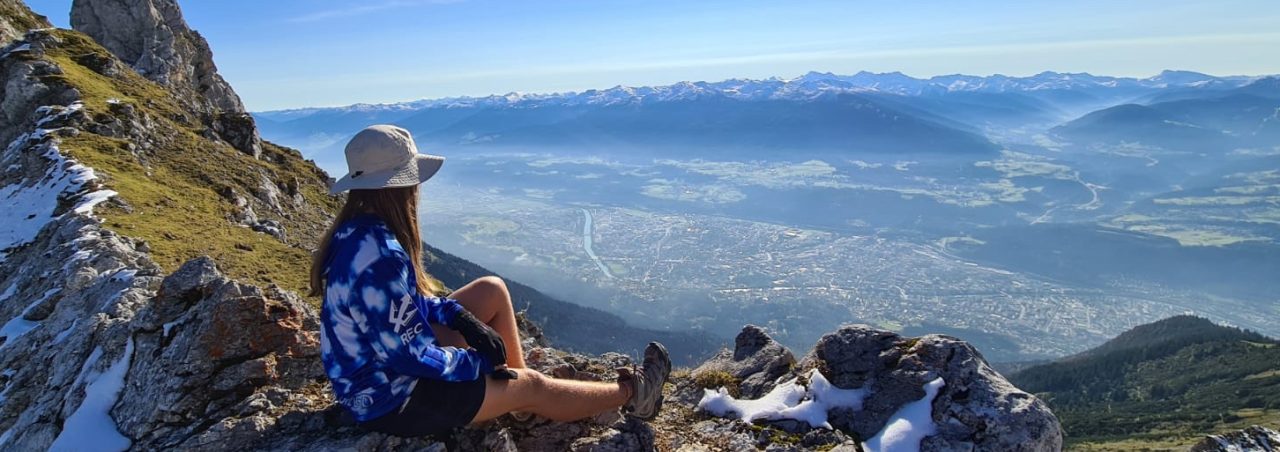
The 3.6 kilometer race was in a valley surrounded by rice paddies next to their school. When I stopped panting long enough to look up, I felt in awe of the natural beauty of the scene before me. The rice paddies are filled with water, so they reflect the mountains above. After a heavy rain the day before, the sky was perfectly blue, with only a few fluffy clouds.

Meika is the younger sister of a boy who I worked with closely last year for the English Speech Contest. Even though she doesn’t know much English yet, I can tell by the way she looks at me that she is interested. (This is a common pattern; if I notice a student looking at me, unblinkingly and without hesitation, I can tell they are interested in English and foreigners, and I try to make more of an effort to talk with them.)

In that moment, running with her, I tried to forget my negativity about my job. I tried to let go the feelings of isolation when people ignore me, and I tried to focus on the beautiful scene that was taking place before me. It was almost like an out-of-body experience; This is my life, I told myself, as I eyed the finish line.

I’m sure Meika slowed down a little bit for me; she kept glancing behind her to make sure I was still there. Huffing and puffing and sweating profusely, I managed to tail her until the end, when we both started sprinting when we saw the finish line. All the boys were waiting there and cheering: “Ganbare!” (“You can do it!”) and “Fight-o!” (“Fight!”) They were so genki! (excited!) and adorable.

Out of 20 runners, she was number 14. I came in shortly after her, so I guess I was 14.5. One of my goals was to not be the slowest runner, so I achieved it!

I want to take this experience, put it in a bottle, and open it again when I feel down or underused. Running with the students, and talking with them after the race, seeing them approach me and make small talk, this is why I came to Japan. I hope that I’m helpful when I repeat the textbooks, or say the words “thirteen” and “thirty” over and over again so students learn the difference, but when students realize that I’m human – tired, sweaty, and wanting to connect and be included – this is when I am making a real impact. When students see me as an equal – not as an authority – outside of the classroom, I feel like I’m making more of a difference. I want to be a good teacher, but I also want to be their friend. When I play sports with them, or connect with them in a non-academic setting, I feel more connected.


Speech Contest for Second-Years

Last month I participated in our annual ni-nensei (second-year) speech contest. The topic, ‘My Favorite Thing,’ was broad enough to elicit a myriad of ideas. Topics ranged from ‘My Clarinet’ to ‘Minecraft’ to ‘Watching the News.’

I was particularly petrified, because my superior asked me to make a speech in Japanese to open the contest. After all, if students have to speak in a language that is not native to them, it’s only fair that I should have to do the same…

I wrote my speech in English, and my supervisor helped me translate it into Japanese. My speech was about a Japanese anime that I recently started watching called “Haikyu.” (It’s about a junior high school volleyball team.) If I had to write genuinely about my favorite thing, I probably would have chosen a different topic, like teaching, nature, sports, traveling, or cooking, but I wanted to choose something my students could relate to.

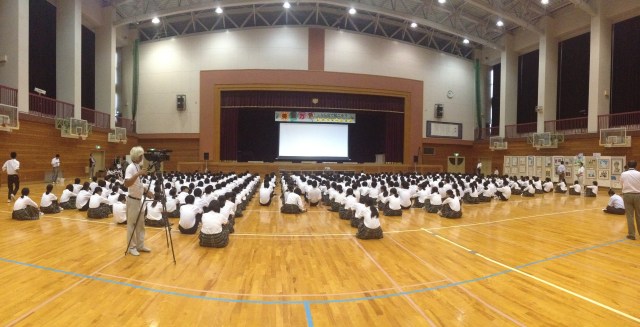
I practiced over and over, showed it to my private Japanese teacher and a few friends, made a few revisions, and painstakingly memorized it. When I got up in front of my audience  of 130 students and 5 teachers, I was visibly shaking.

In stark contrast, ten minutes later, my supervisor asked me to make impromptu commentary between speakers, in English.  I spoke confidently and without a waver in my voice.

I hope that my nervousness made them feel better about their own language learning endeavors.

Thankfully, the next  15 contestants were significantly better than me. I really enjoyed seeing the shy students surprise everyone with their eloquence. One small girl who rarely speaks delivered a lovely speech about her favorite game, Dragon Quest. I’m sure students didn’t realize she was so good at English until they heard her voice amplified from behind a microphone.

The winning speech entitled ‘To The Anime Haters,’ was by a student who lived in Kentucky for the first 8 years of his life. His father is a businessman, and his accent is quite native, with a slightly southern drawl. I think he impressed everyone with his businesslike attitude and native accent, although I doubt that everyone could understand him. Here’s one of his most impressive  lines:  “To make profit from lowering birth rate, internalization,and decreasing population, anime has the potential to become a big industry. This is why I think  anime… is a big chance for Japan.”

I love speech contests, and I already got to accompany one talented student to Tokyo last year for the All-Japan Speech Contest.  Unfortunately, our winner this year isn’t eligible because he lived in America.

However, our second place boy made a beautiful speech about his classmates. His best line was: “Some of my classmates can run fast, are gamers, crybabies, small people, and so on…” It was a good line, because everyone knew who he was talking about.

He has a genuine smile, and good stage presence. If he can think of a good topic, maybe I can take him to Tokyo for the finals, too!

Interview Test

Last week, I interviewed my entire school. There are about 400 students, and I had 2 minutes with each of them. Two minutes to get a sense of their personalities. Two minutes to realize their potential.

I love interview tests.

IMG_1018
I interviewed every student at my school last month.

I told my supervisor this a few months ago, and that I wanted to do them more often. I also asked him to make the interviews longer, since last semester they were only one minute each.

Mostly, I love interview tests because it gives me a chance to connect with students. The students here are so diverse; some enjoy talking with me, and want to talk for longer, and others are so afraid I can see them shaking.

My school asked me to think of the questions myself, and to judge them after the interview. However, it was really tricky to decide their score! As soon as one student left, the next student was coming in, so there was no time in-between to think about it! I judged them on 3 categories: communication, pronunciation/intonation, and attitude. I really enjoyed giving some of the insecure students high scores, because many exceeded my expectations.

Here’s what I asked them:

Ichi-Nensai (First-years) Age 11 and 12 Equivalent to American 7th graders

  1. “What time do you get up? What do you have for breakfast? What is your favorite subject? What do you do after school? What time do you go to sleep?”
  2. “How many sports can you play? What is your favorite sport? When do you play it? Who do you play with?”

Talking with ichi-nensai is fun because they haven’t lost their youthful spirits, so they’re quite げんき (genki; it means enthusiastic.). I can’t post pictures, but just imagine Japanese kids in their school uniforms answering these questions excitedly with exaggerated gestures – so cute!

Ni-Nensai (Second-years) Age 12 and 13 Equivalent to American 8th graders

  1. “Tell me about your family. Do you have any brothers or sisters? Who is the smartest person in your family? Why? What do you do for your family?”
  2. “Which is more interesting, playing outside or reading a book? Why?”

The second question gives them a chance to talk about their favorite sport, which is easy for them. Especially for the students who struggle at English, I like to give them the chance to say anything, even if they always say the same thing over and over. One of my biggest goals here is to raise their confidence and compliment them often, especially the students who are insecure about their English ability.

San-Nensei (Third-years) Age 14 and 15 Equivalent to American 9th graders

  1. Did you enjoy junior high school? Why?
  2. What are your plans for high school?
  3. Who is your favorite person? Why do you like them?

The questions for the older students were broader, which gave them the chance to speak uninterrupted about a single topic for longer, if they could. Alternatively, it gave me the chance to ask a lot of follow up questions. Since I studied journalism, I really like asking questions!

Some interviews were particularly inspiring, but my favorite one was with Yuya*.

Taiki’s Interview Story

There is one very rowdy ni-nensei class at my school, and their teacher is a soft-spoken young woman about the same age as me. I really enjoy working with that class because the students are wild and outspoken, which is quite a stark contrast to some of the shyer and quieter classes, which makes it more challenging.

In that class, Yuya started off this year as the biggest troublemaker. He was clearly the craziest student. During class, he would be constantly talking in Japanese, distracting other students, and he never engaged with the material. Oftentimes he would just ignore his worksheet. Yuya’s tests were always blank. It seemed as if he had made up his mind not to do anything related to English.

When I tried to talk with him about it, he would jokingly respond, “English, no” and he wouldn’t say anything else. He would blabber at me in gibberish and pretend that he was communicating. It was definitely rude, but he did it with a smile, so even though he was making fun of me, I actually appreciated his energy because it was so abnormal in my quiet school.

In his class, there is also a boy named Kaisei* who is basically fluent in English because he lived in America for the first 8 years of his life.

So I often talk to Yuya through Kaisei, with Kaisei translating for me. “Yuya, I think you’re really smart, but you just don’t try,” I’ll say.

Kaisei translates, and Yuya immediately has a snappy comeback: “I hate English. Why should we learn English? I’m Japanese!”

Laughing at his wit, I’ll think of another quick response: ‘People all over the world speak English! Japanese is only spoken in Japan!

He’ll reply: “But I live in Japan. I won’t go abroad. I like Japan!”

It’s hard to argue with him, but I keep trying: “But many people in your class like English! You should try!’ Again, he’d laugh and offer a witty retort. I think I lost the argument.

It was through these interactions that I think Yuya realized he liked talking with me.

So I was really looking forward to two minutes with him. On purpose, he demanded to be the final student from his class to be interviewed by me.  With a ridiculous smile and exaggerated gait, he stomped into the room, waving at his laughing classmates as he entered.

I was amazed that he was able to answer each question, even if it was with his slightly mocking English. Soon the two minutes were up; but he didn’t seem like he wanted to leave, and since he was the last student I kept asking simple questions until the bell rang.

Later, his teacher told me that before the interview, Yuya asked her to translate some of the questions so he could answer them. Coming from a student who was so disengaged at the beginning of the year, I felt really good about his change of attitude.

Another success story related to this is his recent English test: he didn’t leave it blank! He answered more than half of the questions! I almost cried when I saw his test; I was so happy.

Ultimately, my goals with the interview test are to help students realize their potential. Even if they hate English, most of them are capable of a simple 2 minute conversation. I want them to discover that speaking English is actually really fun! Also, I want to open their minds to the outside world. For most of these kids, I’m the first foreigner they’ve ever met. My supervisor said that he didn’t meet a foreigner until he was in high school.

I think I can make a difference to some of them. I can spark something in someone, and make a change, just like my teachers did for me. Ms. Imel in 3rd grade told me I was a good writer. I still remember when she said that to me. In high school, Mr. Lee encouraged me to apply for a short story contest, which I later won. Later I decided to study creative writing and journalism. So our teachers can make a difference.

I hope to be that person for someone.


I can’t post pictures of student’s faces, but I hope you enjoy this random assortment.