Pescatarian in Japan

My one year anniversary of arriving to Japan has just passed, and I have a lot to be grateful for. I have a job, a car, a bike, an active social life, and a surprisingly big apartment, which I especially appreciate because it’s the first time I’ve a kitchen entirely my own. In the past few years, I’ve started to love cooking, and my interest in veganism is adding another layer to life here.

Here are some of my recent concoctions:


Unlike vegetarians, who avoid eating animals, vegans avoid all animal products – no dairy, eggs, gelatin, honey, leather, etc. While I’d like to be fully vegan, I currently avoid meat and dairy, and only occasionally eat fish.

I love my way of life. I buy veggies from local farmers and fruits from the discount shelf at the grocery store. When I eat out, sometimes I have fish, but only for work parties or at restaurants where there is no other option.

I also bring my lunch to school every day, which I enjoy making and preparing. It’s like a present for myself. My Japanese coworkers, students and friends notice my abnormal eating habits, and often they ask me about it. Usually I just say, “Niku tabenai,” or “I don’t eat meat.” Sometimes they follow up with, “Why?” and I say something about “Dobutsu” and “Tomodachi.” (Animals and Friends.) If the person who asks me speaks English, I’ll say, “I don’t want to kill anything,” although my honest answer is a bit more complex.

I’ve been thinking a lot about this recently, because I worry that sometimes I offend people with my beliefs. I hope I haven’t lost any potential friends by sounding too harsh about my feelings. How can I say what I really feel without sounding judgmental?

The truth is, this is one of my most entrenched beliefs, and I am really passionate about it.  If anyone cares to know my deeper reasoning, here I’ll present a more multifaceted answer.

  1. I don’t want to kill or torture

When I was in 7th grade, I did a research project on animal cruelty. During that project, I realized that every hamburger comes from an animal that is imprisoned and tortured before its death.  I  decided then that I didn’t want to be part of that cycle anymore. And recently my beliefs were further entrenched when I watched a documentary called ‘Cowspiracy’ that details the disturbing process of making meat.

Also, when I spent two and a half years traveling in New Zealand, Australia and South East Asia, I volunteered on about 10 farms. I made some close relationships with animals on these farms.

WWOOF

I lived on a small family farm near Invercargill, New Zealand for about 3 weeks. I learned how to milk a goat by hand, and it became one of my morning tasks.

Organic Farm Work

I took this photo of my new friends on a dairy farm in Riverton, New Zealand, where I volunteered for two weeks. After training me and my friend, the owners left for a vacation, leaving us to run the farm without them. There were about 100 cows. We woke up at 5 AM for the morning milking, then had the rest of the day free until about 4 PM to repeat the process.  We fed the cows to distract them from the uncomfortable milking machines, and sometimes dodged pee and poop while trying to extract their milk. (After I realized how dirty and unethical the milking process is, I decided to stop drinking milk.)
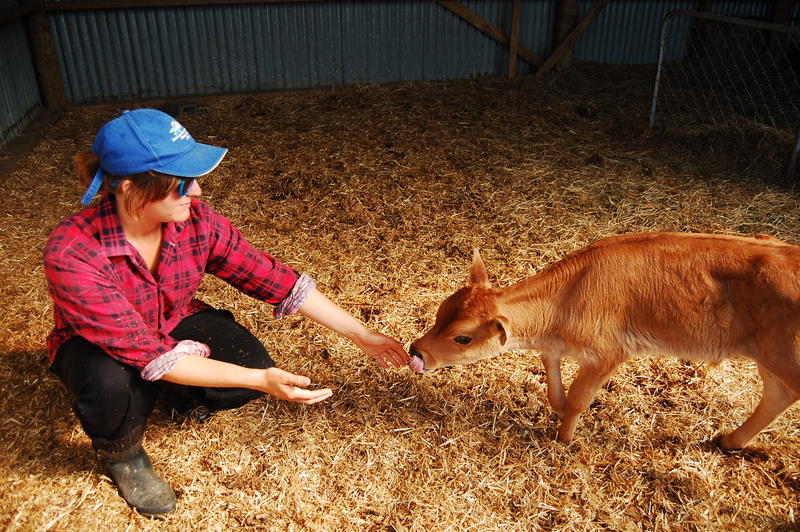
I fed this baby cow whose name was Jack, who was later killed for veal (baby cow).


Since I would never kill one of these animals myself, why should I eat animals that other people killed? I think if someone is going to eat meat, they should have to experience killing an animal themselves.

2. I feel better when I don’t eat meat

Bahay Kalipay

My ideas about food and wellness are profoundly influenced by my two month stay in the Philippines. I volunteered at Bahay Kalipay, a Yoga and Detox Retreat in Puerto Princesa on the island of Palawan. When I was there, we only ate raw food. I lost the weight I had gained from the street stalls in Thailand and Malaysia (where I had taken a brief hiatus from strict vegetarianism), and more importantly I felt a strong and spiritual connection with the food I was eating. The food, yoga, and daily routine was a gateway into a conscious way of living.  I felt like I had superpowers.


The day began at 6am, where we would drink a big glass of lemon water to alkalize our bodies, and then do oil pulling for 20 minutes. (Oil pulling is swishing coconut oil in your mouth, and draws out toxins from your mouth.) Next, we would take a yoga class, drink more water, and then eat breakfast at about 8. A few hours later, a gong would ring, and we would gather again for green smoothies.

In the Philippines, this morning routine was crucial. Now, in Japan, I try to exercise every morning before work (and sometimes after, too) and I have a green smoothie for breakfast almost every day.

 ‘The Blue Zones’

At my last job at the Santa Barbara City College Writing Center, one of my students asked for feedback about her paper on a book called The Blue Zones. After I helped her, I was inspired to read the book. The Blue Zones are 5 places in the world where people live to be over 100 – Okinawa, Japan; Ikaria, Greece; Sardinia, Italy; Nicoya, Costa Rica; and Loma Linda, California.  Author Dan Buettner visited these places and interviewed their elderly, examined their lifestyles, and found what they had in common. The healthiest people in all these countries have a strong social community, an active lifestyle, and a 95% plant based diet.

Except for the 7 day adventists in Loma Linda, California, these centenarians aren’t entirely vegetarian. Most of the Blue Zone countries eat small amounts of meat and fish. Low-impact exercise is an inherent part of their lives, not some chore they must accomplish every day. For example, the Grecian were pastors, hiking up and down mountains daily. The Japanese are outside working in their vegetable gardens even in their 90’s. (I see them in my town!)

After reading this book, I have been trying to incorporate some of their wisdom into my own daily routine. For example, I try to exercise almost every day (although I prefer sports like ultimate frisbee and soccer to low-impact exercise) and eat 95% plants. I stopped drinking milk and eating dairy after my experience on the dairy farm (with an occasional green tea ice cream as an exception… I’m not perfect!)

Here are some photos of the food I’ve enjoyed in the past year.


3. I want to have a small footprint

According to PETA: the Union of Concerned Scientists lists meat-eating as the second-biggest environmental hazard facing the Earth. (Number one is fossil-fuel vehicles.)

In the third-year textbook at my school, there is a section about deforestation of the Amazon Rain Forest. I researched the issue and made an interactive presentation for students. One question I asked them was, ‘Why do you think the forest is being destroyed?’ Their answers were varied, from ‘building a new mall’ to ‘making paper,’ but I found that the leading cause of deforestation is meat production. According to a report from the Food and Agriculture Organization of the United Nations, 80 percent of the deforestation in the Amazon have been covered by pastures for raising cattle.

There are people in many countries who don’t have enough food to eat. Many vegans and vegetarians argue that we should reallocate the food we are feeding animals and give it to the hungry people all over the world.

It takes so much water and land to raise animals that it’s shocking to me that the world is still relying on meat. See the following infograph from PETA for more details.

My views on veganism are multifaceted, and obviously I’m not perfect since I still eat fish and the occasional ice cream. For now, I’ll have to settle for almost vegan. Someone actually just wrote a book called The Book of Veganish (although I haven’t read it yet!)

Even if it’s not happening exactly where I live, I’m glad some parts of the world are starting to wake up to the issue of animal rights. I’m not completely alone; veganism is gaining popularity in the US and Britain ! However, there is one great restaurant about an hour drive from my apartment called Fukamidori that is completely vegan and with a menu that changes weekly. Who wants to go there with me?

14145335_1187376697992879_702413549_n1
A delicious and filling meal at Fukamidori!


Thanks for reading! Any opinions or questions are welcome. Please leave a comment!


Big Questions

Miraculously I’ve learned enough Japanese in the past year to survive in Japan and do adult things by myself, like get gas and buy train tickets .

In order to force myself to study, I found a private tutor who I meet with twice a week. Our  one-hour lessons consist of grammar practice and explanations, and we also enjoy conversation in Japanese about our lives and other big ideas.  He can’t really speak English, so in our lessons we primarily use Japanese.

Last week, he was teaching me the grammar for ‘have to’ and ‘don’t have to.’ For example, どよびにがっこうにいかなくてもいいです。 (doyobi o gakkou ni ikanakutemoiidesu, I dont have to go to school on Sunday.) After I struggled to complete the worksheet he gave me, he introduced a fascinating idea:

じんせいで たいせつな みっつの ことは なんですか?
Jinsei de taisetsu na mittsu no koto wa nandesuka?
What are the three most important things in your life?

Can you guess what he said next? I was so surprised by his answer:

  1. そうじ – souji – cleaning
  2. 笑う – warau – laughter
  3. ありがとう と 言う – arigatou – saying thank you

Actually, I wanted more explanation about these ideas, but I need to ask him again. He did tell me, though, that there is a Japanese proverb that says a clean room and toilet will bring you riches!

After the lesson, I couldn’t help but think about how I would answer the same question. It took me a few days to finalize my answer, and it might change again, but here’s my answer of the moment:

  1. helping others
  2. my health
  3. play

Why? Here’s my explanation:

Helping Others

Since I was born in California to a supportive family with too many blessings to count, I feel like the purpose of my life is to give back to the world in a big, big, big way. I think the purpose of my life is to contribute something major to society.

For example, I met an inspirational American who is currently improving a small community in Tianyar, Bali. Aaron Fishman started East Bali Cashews, and has helped hundreds of Balinese who were previously suffering from malnutrition and poverty. With his dedicated team, he created over 200 jobs for people -mostly women- who were previously unemployed, and started a local preschool with the profits. They hope to replicate their project on other islands after their factory is permanently established.

I volunteered and lived with them for 2 weeks in 2013, which you can see pictures of and read about here. Meeting them and learning about their lives was fate. I’m not sure how or when, but someday I want to do something similar to what they’ve done.

My Health

If I don’t have my health, I can’t help others or enjoy my life. Currently, one of my biggest priorities is eating well and working out.  I’m an adamant vegetarian (with the execption of fish) and try to be vegan as much as possible (for ethical and health reasons.) I want to exercise at least 3 or 4 times a week, and I’ve been successful with this goal because I’ve joined so many fun sports while I’ve been in Japan!

Play

As I grow up, I am losing certain qualities. I am losing the ability to experience true freedom, as I now have to consider now what other people think of me.

But truly, I want to exist in a reality that I create. I don’t want to be controlled by society. I want my actions to be guided by my beliefs, not what society expects of me. I am inspired by small children and their fearlessness. By playing, and showing others that I can experience joy on a daily basis, I hope to inspire others to do the same.

This reminds me of my favorite Marianne Williamson quote:

“Our deepest fear is not that we are inadequate. Our deepest fear is that we are powerful beyond measure. It is our light, not our darkness, that most frightens us. We ask ourselves: who am I to be brilliant, gorgeous, smart, talented, fabulous? Actually, who are you not to be? You are a child of the Earth. Your playing small does not serve the world. There is nothing enlightened about shrinking so that other people won’t feel insecure around you. We are all meant to shine, as children do. It’s not just in some of us; it’s in everyone. And as we let our own light shine, we unconsciously give other people permission to do the same. As we are liberated from our own fear, our presence automatically liberates others.”

I often think of her idea as I’m constantly second guessing myself – should I be doing this? Should I join this Japanese soccer team, even though none of the other players can speak English? Should I go and ask the PE teacher if I can join his class instead of sitting at my desk? Should I try to make friends with the person sitting next to me on the train? Then, I remind myself- my purpose here is not to shrivel up or hide, although sometimes I feel like it. I exist in this world to shine, and to share my positivity.

*        *        *        *        *

Thanks for reading!

I’m curious to hear your answers. What are the three most important things to you?

IMG_5849
View from a weekend hike

Some delightful moments

IMG_5859

For the past 10 months, I’ve been an ALT (Assistant Language Teacher)  at two junior high schools in rural Japan. My bigger school has 380 students and is surrounded by rice paddies and rolling green hills. My visiting school is in a mountain valley that is famous for watermelon, and only has 40 students. I’m the only foreigner at both schools, and every day is rich in different ways. Some days I’m bored and unsatisfied, while other times I feel a deep and profound connection with students and teachers. I could easily complain, but its much more fulfilling and beneficial for my well-being to focus on the good. Here are a few of my best moments from the past few weeks.


Making Friends with the Music Teacher, 5/25

After lunch I usually alternate between playing basketball in the gym, playing frisbee outside, patrolling the halls trying to find students to talk to, or decompressing at my desk. For students, these precious 20 minutes are the only free time they have all day.

On this particular day, I had just finished eating lunch in the noisy cafeteria, and I was walking with the new music teacher who barely speaks English. I feel a connection with her because we are almost the same age, but my Japanese is poor and her English is nonexistent.

In past conversations, I’ve asked her simple questions in Japanese – なんさいですか (Nansai desu ka? How old are you? ) but I couldn’t think of anything in this moment.

But suddenly I remembered that she had studied concert piano, so after our typical “How are you?” exchange, I spontaneously blurted, “I want to hear you play the piano!” To my delight, she understood, and answered: “Okay!” with a big smile. “When?” I asked. “Now?” she replied.

Sometimes my impulsiveness gets me in trouble; other times it brings me miracles.

We hurried past giggling groups of pre-teens to the music room. She sat at the piano bench, spread her music out, and began to play. For the next 20 minutes, I felt like I had transcended my own reality. I could sense her years of training in her posture and subtlety. Just an hour ago we were struggling to communicate, but now I felt we had unified.   As she played, the language wall that had existed a few minutes ago seemed to dissipate.

Then, she pulled out the sheet music for ‘Frozen,’ and I belted it kareoke style. A few students stuck their heads in, wondering what was going on. When the bell rang, it was like the wall had risen again, but with a few cracks this time. Now we have a connection, and as we continue to communicate, the language barrier will crumble.

IMG_5991


Amber’s Passport, 6/2

I’m always looking for excuses to share my ideas, rather than just read and repeat the textbook. Recently, there was a good chance for this in ni-nensei (2nd year) classes. Their unit features a young traveler showing their passport to a customs officer at the airport. As an avid explorer, I am really excited about travel and wanted to share my feelings. So I projected my passport on the overhead screen and showed them my stamps. I encouraged them to read out loud  the names of the countries I’ve been to in the past few years:

~ New Zealand ~ Australia ~ Thailand ~ Cambodia ~ Vietnam ~ Taiwan ~ Indonesia ~ Malaysia ~ The Philippines ~ Japan ~

After college I traveled for 28 months, with about 9 months in New Zealand and 10 months in Australia with working holiday visas, and the rest of the time bouncing around Southeast Asia.  This time abroad hugely impacted my sense of self. It made me more independent and confident.  I hope that students can feel my attitude and be inspired to have their own adventures.


“Hello Goodbye” 6/8

At my visiting school, there is a small class of about 12 ichi-nensei (first year) students  who always expect me to sing as soon as I walk in the room. I’ve only taught their class about five times, and every time I’ve brought my ukulele and sang for them before the JTE (Japanese Teacher of English) arrived.

I didn’t have my ukulele, but I was surprised that one girl knew the word a cappella! She approached me and opened the textbook to a page with songs on it. One of them was “Hello Goodbye” by the Beatles. I waved over another girl to sing with me. I imagine it was quite a shock for the JTE to see me and the student belting out a tune in front of her friends before we had even started class.


“It’s A Small World After All,”  5/30

In the san-nensei (3rd year) textbook, there is a brief mention of the song “It’s a Small World.” So naturally, I borrowed my teacher’s guitar and sang it for the class, without any practice. At first I struggled to find the right key and made a few mistakes, but I think it went rather well because my JTE (Japanese Teacher of English) asked me to sing it for all his classes.

Sometimes, I wonder if these students think I’m crazy when I burst out into spontaneous song (and dance) in class. I hope to not only teach them English, but also show them that its okay to be loud and inspired and weird.