Interview Test

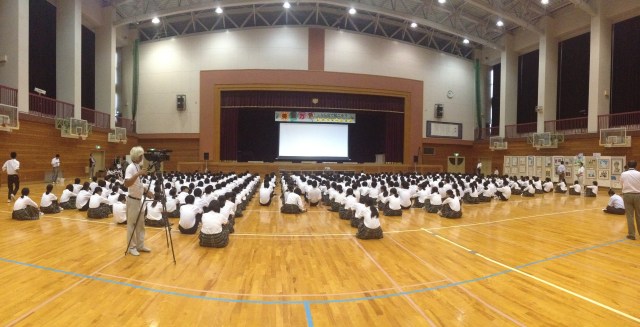
Last week, I interviewed my entire school. There are about 400 students, and I had 2 minutes with each of them. Two minutes to get a sense of their personalities. Two minutes to realize their potential.

I love interview tests.
IMG_1018
I interviewed every student at my school last month.

I told my supervisor this a few months ago, and that I wanted to do them more often. I also asked him to make the interviews longer, since last semester they were only one minute each.

Mostly, I love interview tests because it gives me a chance to connect with students. The students here are so diverse; some enjoy talking with me, and want to talk for longer, and others are so afraid I can see them shaking.

My school asked me to think of the questions myself, and to judge them after the interview. However, it was really tricky to decide their score! As soon as one student left, the next student was coming in, so there was no time in-between to think about it! I judged them on 3 categories: communication, pronunciation/intonation, and attitude. I really enjoyed giving some of the insecure students high scores, because many exceeded my expectations.

Here’s what I asked them:

Ichi-Nensai (First-years) Age 11 and 12 Equivalent to American 7th graders

  1. “What time do you get up? What do you have for breakfast? What is your favorite subject? What do you do after school? What time do you go to sleep?”
  2. “How many sports can you play? What is your favorite sport? When do you play it? Who do you play with?”

Talking with ichi-nensai is fun because they haven’t lost their youthful spirits, so they’re quite げんき (genki; it means enthusiastic.). I can’t post pictures, but just imagine Japanese kids in their school uniforms answering these questions excitedly with exaggerated gestures – so cute!

Ni-Nensai (Second-years) Age 12 and 13 Equivalent to American 8th graders

  1. “Tell me about your family. Do you have any brothers or sisters? Who is the smartest person in your family? Why? What do you do for your family?”
  2. “Which is more interesting, playing outside or reading a book? Why?”

The second question gives them a chance to talk about their favorite sport, which is easy for them. Especially for the students who struggle at English, I like to give them the chance to say anything, even if they always say the same thing over and over. One of my biggest goals here is to raise their confidence and compliment them often, especially the students who are insecure about their English ability.

San-Nensei (Third-years) Age 14 and 15 Equivalent to American 9th graders

  1. Did you enjoy junior high school? Why?
  2. What are your plans for high school?
  3. Who is your favorite person? Why do you like them?

The questions for the older students were broader, which gave them the chance to speak uninterrupted about a single topic for longer, if they could. Alternatively, it gave me the chance to ask a lot of follow up questions. Since I studied journalism, I really like asking questions!

Some interviews were particularly inspiring, but my favorite one was with Yuya*.

Taiki’s Interview Story

There is one very rowdy ni-nensei class at my school, and their teacher is a soft-spoken young woman about the same age as me. I really enjoy working with that class because the students are wild and outspoken, which is quite a stark contrast to some of the shyer and quieter classes, which makes it more challenging.

In that class, Yuya started off this year as the biggest troublemaker. He was clearly the craziest student. During class, he would be constantly talking in Japanese, distracting other students, and he never engaged with the material. Oftentimes he would just ignore his worksheet. Yuya’s tests were always blank. It seemed as if he had made up his mind not to do anything related to English.

When I tried to talk with him about it, he would jokingly respond, “English, no” and he wouldn’t say anything else. He would blabber at me in gibberish and pretend that he was communicating. It was definitely rude, but he did it with a smile, so even though he was making fun of me, I actually appreciated his energy because it was so abnormal in my quiet school.

In his class, there is also a boy named Kaisei* who is basically fluent in English because he lived in America for the first 8 years of his life.

So I often talk to Yuya through Kaisei, with Kaisei translating for me. “Yuya, I think you’re really smart, but you just don’t try,” I’ll say.

Kaisei translates, and Yuya immediately has a snappy comeback: “I hate English. Why should we learn English? I’m Japanese!”

Laughing at his wit, I’ll think of another quick response: ‘People all over the world speak English! Japanese is only spoken in Japan!

He’ll reply: “But I live in Japan. I won’t go abroad. I like Japan!”

It’s hard to argue with him, but I keep trying: “But many people in your class like English! You should try!’ Again, he’d laugh and offer a witty retort. I think I lost the argument.

It was through these interactions that I think Yuya realized he liked talking with me.

So I was really looking forward to two minutes with him. On purpose, he demanded to be the final student from his class to be interviewed by me.  With a ridiculous smile and exaggerated gait, he stomped into the room, waving at his laughing classmates as he entered.

I was amazed that he was able to answer each question, even if it was with his slightly mocking English. Soon the two minutes were up; but he didn’t seem like he wanted to leave, and since he was the last student I kept asking simple questions until the bell rang.

Later, his teacher told me that before the interview, Yuya asked her to translate some of the questions so he could answer them. Coming from a student who was so disengaged at the beginning of the year, I felt really good about his change of attitude.

Another success story related to this is his recent English test: he didn’t leave it blank! He answered more than half of the questions! I almost cried when I saw his test; I was so happy.

Ultimately, my goals with the interview test are to help students realize their potential. Even if they hate English, most of them are capable of a simple 2 minute conversation. I want them to discover that speaking English is actually really fun! Also, I want to open their minds to the outside world. For most of these kids, I’m the first foreigner they’ve ever met. My supervisor said that he didn’t meet a foreigner until he was in high school.

I think I can make a difference to some of them. I can spark something in someone, and make a change, just like my teachers did for me. Ms. Imel in 3rd grade told me I was a good writer. I still remember when she said that to me. In high school, Mr. Lee encouraged me to apply for a short story contest, which I later won. Later I decided to study creative writing and journalism. So our teachers can make a difference.

I hope to be that person for someone.


I can’t post pictures of student’s faces, but I hope you enjoy this random assortment.


My role at school: friend, teacher, or in-between?

After lunch, I go to the staff room and see my fellow teachers peering out the window, chuckling as they watch students throw snowballs at each other. But I don’t want to stand there and watch the fun from afar.

So I slip into my rubber boots and enter the chaos. I make a snowball, and decide that the baseball captain is my first target. He looks shocked, but retaliates; luckily, I dodge it.

IMG_3824
This is where the snowball fight occurred.


Now that I’m in, there’s no going back. I lob snowballs at the giggling packs of girls and chase after the troublemakers. Even the shyest students who barely speak to me are creating attack formations. Before I know it, I’m laughing and running from students who are pelting snowballs at me.

So what is my role at this school? Am I a teacher, a friend, or somewhere in-between? While I aim to be respected, I don’t want to be an unapproachable authority. Sometimes I want to jump in the action and feel like I’m one of them. Ideally, students will be comfortable around me, even if they don’t like English.

When I first came to Japan, I met a Japanese teacher at the Fukui City Summer Camp who had been teaching for over 40 years and worked with more than 20 ALTs (Assistant Language Teacher). So I asked her a question I have repeated over and over, to any teacher willing to answer:

What makes a great ALT?”

She said, “Great ALTs play with the students.”

What a simple answer! Yet so profound.

Later, at a JET conference I was told the secret to being a great ALT was to arrive more than 10 minutes early. I was not satisfied with this answer. To me, it showed that fitting into the culture is more important than any skills or creativity. I was annoyed because I don’t always equate myself with fitting in. I think of myself as free spirited and unique, and I hope to spread my unorthodox ideas to students and open their minds with my weirdness. Do any other teachers at my school have snowball fights, or dance the macerena in the hallways? Is it okay if I wear colorful mismatched socks?

Maybe I worry that I’m not being professional, but I have to remember that I’m a different breed of teacher: one closer to their age, and their mindset. Even though I’m 25, I pride myself in my immaturity. I want to be like a child, free of judgment and unafraid of what other people think of me.

But at the same time, I find myself wondering if it is professional to play catch in the classroom with an eraser. I did this with one boy from the baseball team who seems to hate English. At the time, I was happy that we were interacting, because he usually associates me solely with English and only scowls at me. After the fact, I couldn’t help but question myself. As a teacher, was I supposed to chastise him for throwing an eraser in class? Instead, I followed my gut and just started playing.

Even though I’m still not sure if my behavior is appropriate, I’m beginning to realize that my time outside of the classroom is where I can build my strongest relationships with students. So I’ve been going to after-school clubs and sports, joining PE classes, and wandering the halls during free time and after lunch.

A few months ago I was beginning to feel depressed at work. There was a big test coming up, so most teachers were too busy to acknowledge me. I had no classes scheduled for a few days, and I felt ignored and isolated. I would walk the halls between classes, trying to engage with students, but besides that I had nothing to do all day. I told my supervisor this, and he told me: ‘Don’t feel isolated! We like you. But we’re busy!’

Unfortunately this didn’t solve the problem. So I had to take action.

I needed to create something to look forward to, so I decided to ask the PE teacher if I could join his class. To my surprise, he checked the schedule and instantly aid yes! I often worry that I might inconvenience people, but the PE teacher welcomed me.

So I joined a kendo class later that day. I took off my shoes, and sat on the ground next to the students, and pretended to be able to understand what he was saying. He loaned me a bamboo sword. I floundered about, not sure what to do, but students rose to the challenge and stepped up to give me instructions in English. Suddenly, there was an instant role-reversal: they were the experts, and I was clueless. I hope that they felt empowered by teaching me.

Later, I joined a first-year PE class where students were doing gymnastics. The PE teacher seemed thrilled to learn the English word for ‘handstand’, and I was able to show off my cartwheeling skills. Most importantly, I had fun cheering and high-fiving students after they performed their acrobatics.

Whenever I join a sport, my aim is to boost student’s egos. So far I’ve tried basketball, volleyball, table tennis, track and field, soccer and badminton. Playing sports with them forces them to connect with me, even if they are the type who typically avoid eye contact in class.

At basketball practice, the captain took me aside and gave me some pointers on shooting technique. This student doesn’t particularly like English, but because I showed interest in his sport, he wanted to share his skills with me. I felt lucky that he gave me his unsolicited one-on-one attention!

I was worried that the track and field team would leave me in the dust,  but I was happy to find that they were cheering me on. They even invited me to practice with them again.

So should I throw erasers in classrooms? Should I join the snowball fight? Should I showcase my weirdness? Until I hear someone tell me not to, I’m going to keep doing it. It makes my job more fun, and deepens my connections with my students. I’m here to be involved, so I might as well take action.


I can’t post photos of my students, but I hope you enjoy my snow photography!


Tokyo Speech Contest: Journey to the Finals

Every time I take a weekend excursion, I feel like I am in full-flung travel mode again. Flashback to my 28 months on the road. It’s just me and my backpack, and I’m free to go anywhere.

With my job as English teacher in rural Japan, I can have this sensation every weekend, if I want.

IMG_2997
This is the moat around the Emperor’s Palace in Tokyo.

But what made this trip unique was its purpose: I was traveling to Tokyo for one of my students. My student Yuta* had miraculously made it to the finals of the 67th All Japan Inter-Middle School English Oratorical Contest.

Our journey began when I arrived at my new workplace in early August. On my desk was a speech, which Yuta had written in Japanese and the previous ALT had translated into English. However, my supervisor suggested that we give it an overhaul. My supervisor, a creative and spontaneous English teacher, has a knack for speeches. In his 20 years of teaching he has brought 9 students to the finals in Tokyo. So the two of us – me, as a creative writing major, and he as an experienced teacher – made a great team for helping Yuta reach his potential.

Yuta has been going to private English lessons after school for many years. Unlike most students, he looks you in the eye when he’s talking to you. Even though he’s a little small for his age, his loud voice and strong opinions often make him the center of attention. I’ve seen him in his classes; he’s not your typical shy Japanese kid.

Yuta and I started practicing after school, for an hour or more. At the beginning, it was mostly talking about his ideas, and trying to find the right words to express them. Google translate helped a lot. After about 10 revisions, we had settled on the final draft. He must have learned dozens of new words in the process.

Soon, it was time for the local contest. About 60 students from local junior high schools gathered at a community center to give their 5 minute speeches to a room filled with at least a hundred teachers, parents, and fellow students. For most of the day, I practiced with Yuta outside. When it was his turn, he spoke in a big, passionate voice. Unlike the previous speaker, who forgot her speech half-way through, Yuta’s natural confidence and enthusiastic personality made him truly shine. I couldn’t help but cry as I watched him. I felt so proud to know him.

He won second place in the local contest that day, and the top three students were invited to the national competition in Tokyo! The first place winner from our local bracket was a Brazilian girl who spoke about her multifaceted relationship with her mother.

Soon it was time to prepare for Tokyo. Yuta asked me if I wanted to practice three times a day: before school, after lunch, and after school. I felt honored that a student wanted to spend so much time with me. At our practices, I always asked him, ‘What do you want to do today?’ This simple question is an example of something I learned while working at the SBCC Writing Center. Letting a student direct the interaction makes them feel more connected with the lesson.  Yuta seemed to appreciate the power to decide what to do.

He would usually ask for help with his pronunciation. He used to say ‘muzzer’ instead of ‘mother,’ and any word with an L or R is often challenging for Japanese people. So we practiced words like ‘recently’ ‘learn’ and ‘school’ many, many times.

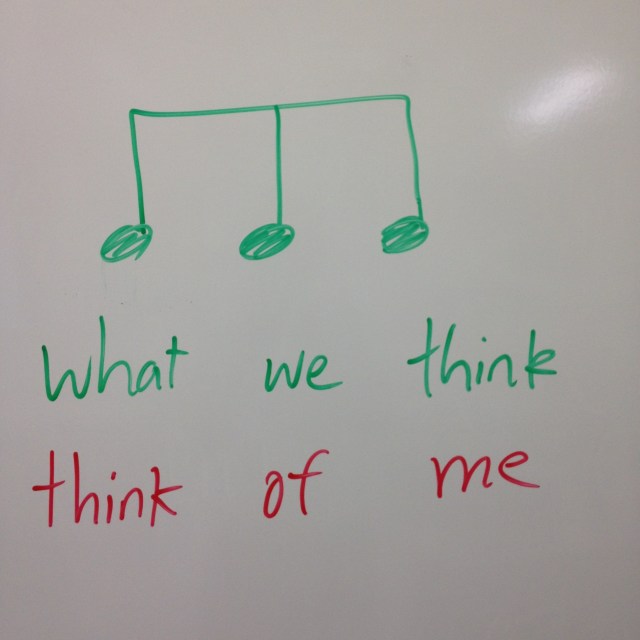
It was fun for me to experiment with different teaching methods. For example, when he said, ‘We are not afraid to say what we think,’ I told him to put equal weight on the ‘what we think’, clapping to illustrate the rhythm of the phrase.

IMG_1508
When I was helping him, I thought of comparing words to music.

Five Days in Tokyo: A Hiatus from Reality

I was the only ALT from Fukui to accompany a student to Tokyo, and only because I fought for it. I had a feeling that this might be a once-in-a-lifetime opportunity, so I told my supervisor I really, really wanted to go, and he listened. Sure, I had to take time off and pay my own way, but I still feel incredibly grateful.

The night before I was supposed to leave, I was so excited I couldn’t sleep. I met my JTE (Japanese Teacher of English) Mr. Yamada*  on the train. We opted for the fast train – called the shinkansen – which travels at an average of 170 miles per hour. We were in Tokyo in 3 hours. (It’s a 6 hour drive!)

Yuta and his family had driven to Tokyo the night before. Once we found them, we practiced in his hotel room for a bit, and parted ways. Yuta was in a hotel payed for by the speech contest – he got to share a room with other participants. I know he made a lot of new friends! I spent the night at a friend’s house to save money.

The next morning it was Yuta’s turn to give his speech at the semifinals. I took detailed notes about the other speakers and made predictions. As I watched them, I couldn’t help but think that he had a chance to move forward. As his turn approached, my stomach started doing somersaults. I think I was more nervous than he was! When it was his turn to speak, again I couldn’t help but cry. Tears rolled down my face as I watched him shine, confident and pure-hearted, unafraid.

And miraculously, he made it! Out of the 33 students from the Northern Japan Region, he was in the top 7, earning him a coveted spot in the finals the following day.

Held at a fancier location in a bigger auditorium, the atmosphere at the finals was thick with nerves. These were the most talented junior high school English speakers in Japan, all in one room!

I was astounded by the inspiring topics and impeccable delivery from these kids. They spoke about important real world issues, such as Japan’s relationship with Korea and the 70th anniversary of World War II.  Several shared  captivating anecdotes about overcoming bullying and bigotry. One of the finalists had a German father, and spoke about her dual identity as both Japanese and German.

Most of the participants were from private schools; only 8 students out of the 30 finalists were from public schools. (Yuta was one of them!) Many of them spoke with a British accent, and some truly sounded like native speakers.

During the breaks, I conversed with several of the contestants, and was impressed by how comfortable they were talking with me.

IMG_3131
This is the banquet hall where we had a reception for the speech contest. There must have been a thousand students, teachers, and parents here!

The Results

Unfortunately, Yuta didn’t make it in the top 7. And yes, I cried again when he gave his speech. I’m incredibly proud of him. After all, he was one of the best 30 speakers in all of Japan.

After the contest, I paid a ridiculous sum to attend the closing banquet, where I got to see a Japanese princess speak with a British accent, congratulate all the students and present the final award. The first-place speaker was a girl from Okinawa who urged listeners to turn off their smartphones and pay attention to the world.

When I was back at school, my supervisor asked me to do a write-up about my impressions about the speech contest. You can read my conclusions here:

What makes a great speech? After watching my student participate in the finals of the 67th All Japan Inter-Middle School English Oratorical Contest speech contest, I have drawn some conclusions. The speeches were judged based on three categories: Content, English and Delivery. Therefore, the winners must have an interesting topic, be easy to understand, and connect with the audience.

 First and foremost, a great speech must have unique and captivating content. In the finals, no two speeches had the same topic, although some of them had overlapping themes. The winning speech was about how smartphones are changing society. The second place winner spoke about the importance of names. Yuta’s speech, titled ‘Children are our Teachers,’ was about learning from children. He urged listeners to retain childlike qualities like enthusiasm, bravery and innocence even as we grow up.

 Secondly, every speech in the finals was easy to understand. The finalists all spoke clearly and I could comprehend every word of their speeches. Many of the speakers, such as the first place winner, sounded like native speakers. However, students with a noticeable accent – like Yuta– were still successful in conveying their message.

Lastly, the speakers in the finals all had the ability to connect with the audience because of their confidence and humor. Like Yuta’s speech, the top winners all made the audience laugh. A speaker must have a strong personality, and have the confidence to speak loudly on stage in front of hundreds of people.

All in all, I am extremely grateful for the experience of working with my students and fellow English teachers during this speech contest, especially Yuta. Both he and I learned a lot from each other. I hope that next year I can take another student from Midori* Junior High School to the finals in Tokyo!

*I changed the name of my student, the teacher I was working with, and my school to protect their privacy.

Unfortunately I can’t post pictures of my students on the blog. So here are some random photos from my trip. The speech contest was only one part of my 5 days in Tokyo. In addition, I visited a fish market, played ultimate frisbee, met up with a few old friends, and experienced Tokyo nightlife. Yay for adventures!