Since I grew up in Southern California, the snow is exciting for me!
If you start humming ‘Rudolph the Red-Nosed Reindeer,’ most Japanese junior high school student’s eyes will light up, because they know the Japanese version: “Makka na ohana no tonakaisan wa itsu mo minna no waraimono. ” (The English translation of their first line: “The reindeer with the bright red nose, always a laughing-stock to everyone.”)
Or, if you bring your ukulele to school, and invite the entire school to sing Christmas carols with you after lunch, you can expect everyone to sing along.
Christmas as an ALT is one of the best parts of the year, second only to Halloween where we can wear our costumes to school and give out Halloween stickers (or candy, depending on the school.)
Last December, I recruited some teachers to sing Christmas carols with me to students after lunch. At my smaller school, the 居と先生 (kyoto sensei, or vice principal, who is also a music teacher) played the piano, I sang and played the ukulele, and a musically-inclined social studies teacher gave some nice harmonies for “Silent Night” and “Jingle Bells.” This year I asked them again, but on the day we had planned to sing together the vice principal had to guard the phones in the office and the social studies teacher suddenly got sick and went home, so it was up to me to bring the Christmas spirit alone. I chose “We Wish You A Merry Christmas.”
I had a great worksheet with the lyrics in English and Japanese thanks to a very talented principal (and English teacher) at an elementary school in my town who made a translation for her students. When I visited her school, she had all of her English classes sing it as a warm up. I made copies of her lyrics and brought them to my other schools so students could understand and pronounce the words correctly.
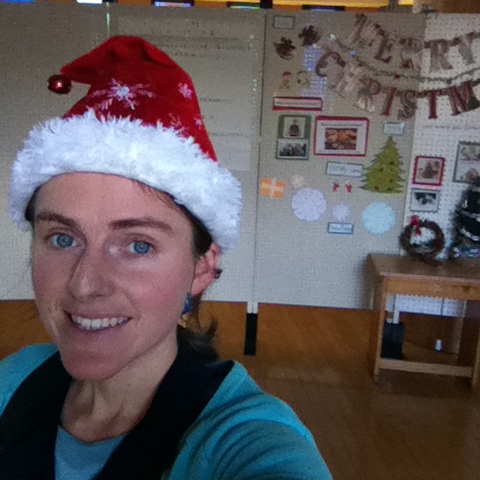
I had sung this song dozens of times in front of other classes, but this time I was a bit nervous because it was the first time I was gathering the whole school by myself. They surrounded me at the piano, and I passed out the lyrics with translations in English and Japanese. I wore my magical Christmas hat and played my ukulele, and we sang: “We Wish You A Merry Christmas.”
To the students shock, I asked the crowd, “Can someone play the piano?” I knew it was almost an impossible request – imagine playing a song you haven’t practiced for the first time in front of your entire school! – but there are some talented pianists, so I thought I’d ask.
Besides Christmas carols, talking about holidays in Japanese schools is fun because students don’t know much about them, and its a nice respite from their textbook. It’s our chance to teach them about an important part of our culture. I made a powerpoint with photos of sparkling houses, Christmas tree lots, gingerbread houses, and so on. After the presentation, we sing “We Wish You A Merry Christmas” as a class.
Whenever I deliver my presentations, I try to pepper my talking with questions. “What’s this?” “Do you have a tree at your house?” “What do you do for Christmas?” After a year of teaching at my Junior High, I’ve come to realize that most students don’t want to be lectured in English (or any language, probably) for more than about 30 seconds before their eyes start to glaze over. I try my best to make my talking as interactive as possible, with time for them to discuss ideas with partners and with clarifying questions at the end. I also try to use grammar they’ve recently learned.
Another fun thing about Christmas is that it gives us a chance to decorate the school. Thanks to my Facebook newsfeed I was seeing other ALT’s creative Christmas inventions, which prompted me to make my own. My British friend Becky (who is also a designer, you can see her work here) made a one month advent calendar for students.
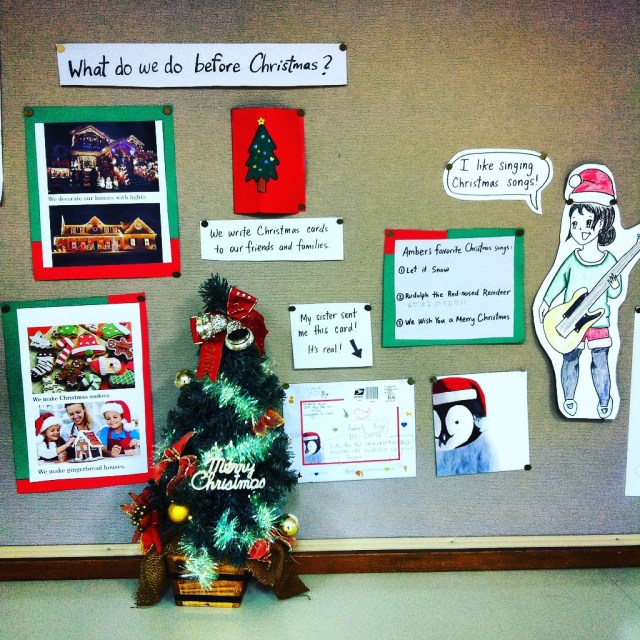
Mine weren’t quite as extravagant, but I’m still happy with how they turned out. I tried to make them educational with question and answer style format. I have two schools, so I made two of them.
After I made this board, two of my students approached me and asked me to sing ‘Let it Snow’ for them, because I listed it as my favorite Christmas song!
Here’s my Christmas board from my base school. I recruited a special education class and their teacher to help me make it.Thanks to my friend Tony who gave me this magic hat last year. It sings and dances!!!
If you had asked me last week, “When are you leaving Japan?” I would have answered, “Next summer.” I really thought I had made up my mind to leave. I have to sign the paper on January 10th, so the next few weeks I have to finalize my decision. Recently I’ve been analyzing my days, good and bad, trying to see if it’s worth it for me to stay a third year.
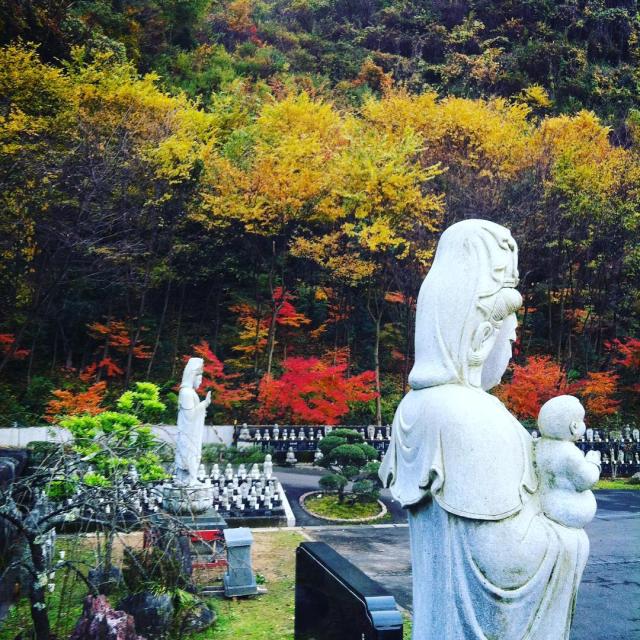
These statues at Nishiyama Park have wisdom to share.
Last week was test week. Students are so busy with studying they can barely breathe, let alone take a break to practice speaking English (which isn’t included on the tests, only reading, listening, and writing) so during those weeks I feel isolated and underused. I could be wrong, but it seems like at least once a month there is some kind of big test for all students.
On days when I know I won’t be utilized, waking up early and exercising and riding my bike to school helps me stay sane. I decided that unless its raining or snowing, I’m going to bike to school. It’s better for the environment, my health, and its just more fun. It wakes me up in the morning and makes me feel alive. Plus, most of my students bike to school, so why shouldn’t I?
As I leave my apartment I can see my breath, and I have a specific and addictive feeling that seems to drive a lot of my choices: I’m insane, but I like this feeling. (I think it’s the same feeling my dad has when he is doing 100 mile races, or climbing via ferratas by himself in Switzerland.)
Here’s my dad running a 3-day, 70 mile race in Italy and Switzerland. September 1-3, 2016.
When I arrived at school, I was bombarded by a chorus of greetings: “Good morning! Hello! Hi!” which is quite a stark contrast from how students used to treat me last year. One of the most amazing things about being a teacher is seeing students change. My entire school has taken a turn for the better – even the students who hate English smile at me and greet me now.
During first period, I planned a lesson for ni-nensei students (equivalent to American 8th graders) relating to a page in their textbook about a place in Fujian, China. There are three-story round houses that 80 families live in, so the character in the story lives next to 300 other people. I made a powerpoint showcasing three different houses – stilt houses in Cambodia, a mansion in America, and my own house in Santa Barbara, California – along with a comprehension worksheet. The JTE (Japanese Teacher of English, who is always in the room while I’m teaching) said, “You can teach the class for the first 15 minutes.” But when 15 minutes had passed, I just continued and he stayed in the back of the class, giving me complete power to lead the class for the full 50 minutes. I felt like a real teacher, although a bit disorganized, because I only expected to lead the first 15 minutes not the whole class.
Today I also had two interview classes with ni-nensei (about US 8th grade) students. My goal is to make it a fun experience for them, so I try to ask questions that I’m sure they can answer – but it’s really challenging and exhausting, because I have to think quickly. There’s barely time to breathe between students, and I also have to score them. One strict teacher urged me to give low scores to motivate them to study more, while another said that slightly higher scores will make them feel good about themselves. I tend to give higher scores and I write a comment on every interview sheet. Even students who are nervous and can barely say anything get a smiley face and a note that says something like, “Nice smile and eye contact!”
Another class today was team teaching with Mr. Imajo*. He brings English to life, and makes it a real, living, breathing, ever-changing animal for students, instead of a stoic dictionary needing to be memorized. Today, students made their own quizzes and the class became a game show. He divided the class into teams, and they competed for points. Students had to say their quizzes aloud in the front of the class and others had to guess the answers. There were a lot of laughs in that class.
I can’t post pictures of my students, so here is a stand-in.
My school life has drastically improved lately also thanks to one student. Makoto* was the captain of the basketball team last year, and since I joined a few practices, he taught me how to shoot properly. Over the summer, he made some foreign friends that he chats with on the internet, and he came back to school with a newfound passion for English. Unlike most students, he is not shy, and lately he’s been wanting to talk with me every day. A few times, he’s asked me, “Do you want to eat lunch with me?” which really made me feel valued, since sometimes I feel like I’m forcing my presence upon students who are terrified of speaking English and making mistakes. Today, he asked me, “Can you teach me how to write in cursive?” I really enjoy spending time with him, since he is so interested in foreign culture and English. He’s told me really nice things, like,” I can improve my English thanks to you.”
Every day after cleaning time, I stand in the hallway and say “Hi” to the students who are walking by, hoping that someone will stop and talk with me. Usually Makoto stops to talk to me, but today one boy who had never approached me before came up to me and started trying to teach me Japanese. “Ka ki ku ke ko,” he said, gesturing for me to repeat. “Ka ki ku ke ko,” I obliged, laughing. Of course other students were watching the interaction too. I think every interaction has the chance to impact many people, because those watching may be affected, too.
Biking home in the dark with my students builds camaraderie, and they are surprised to see me on my bike. “I saw you on your bike today!” One student said to me, who has never spoken with me before. I see them changing before my eyes.
This is my view while I’m biking home from school.
And, here is my everchanging list of reasons.
Reasons to stay:
I have a good job with great pay, health insurance, and wonderful vacations.
I have my own apartment, car, bike, ukulele, and electric piano. I have everything I need for a comfortable life.
My situation at school is improving. While I was quite unhappy and feeling isolated last year, I’ve been able to make friends with some teachers this year who make a small effort to communicate with me. The problem is that I can’t understand Japanese very well – I can have a basic and simple conversation, but it’s not really enough to make friends with someone who can’t speak English.
The ALT (Assistant Language Teacher) social scene in Fukui is wonderful. I have a varied group of multicultural friends. I have friends from Japan, Ireland, Jamaica, America, England, etc… I have a host family who I barely have time to see. I’ll really miss them when I leave!!!
There’s still a lot of traveling I want to do in Japan: Hokkaido, Okinawa, Hiroshima… I love couchsurfing and volunteering on farms, so besides transportation I can visit most of these places for free. (But I can do this anywhere in the world, too!)
My myriad of extra-curricular activities is adding to my skill-set:
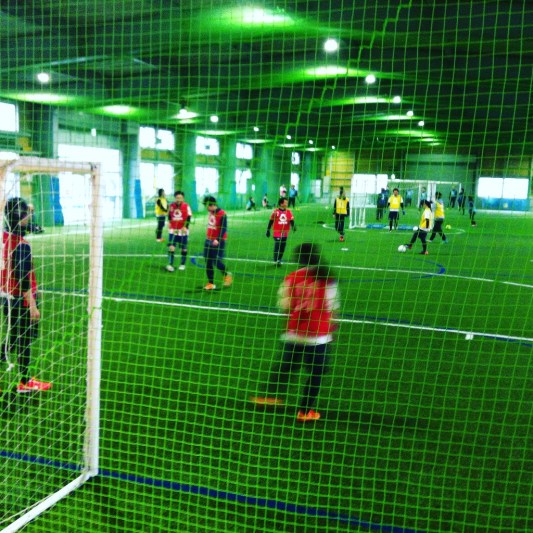
I have two soccer teams, one all-girls on Thursday nights, and one foreigner group that plays against Japanese teams and meets almost every weekend.
I’m in a band that performs a few times a year, and I’ve had the chance to sing on-stage at festivals to a few classic songs like “Stand By Me” and “We Are the World.”
I know about two dance groups – one salsa group on Tuesdays (only 10 minutes from my apartment), and another ballroom on Friday (an hour from my apartment). I also heard about a ballet class that I haven’t gone to, but I’d like to try!
Last year, I was in an adult choir on Saturday nights that sang old, traditional Japanese songs plus a few in English, like “You Raise Me Up.” I stopped going this year, though.
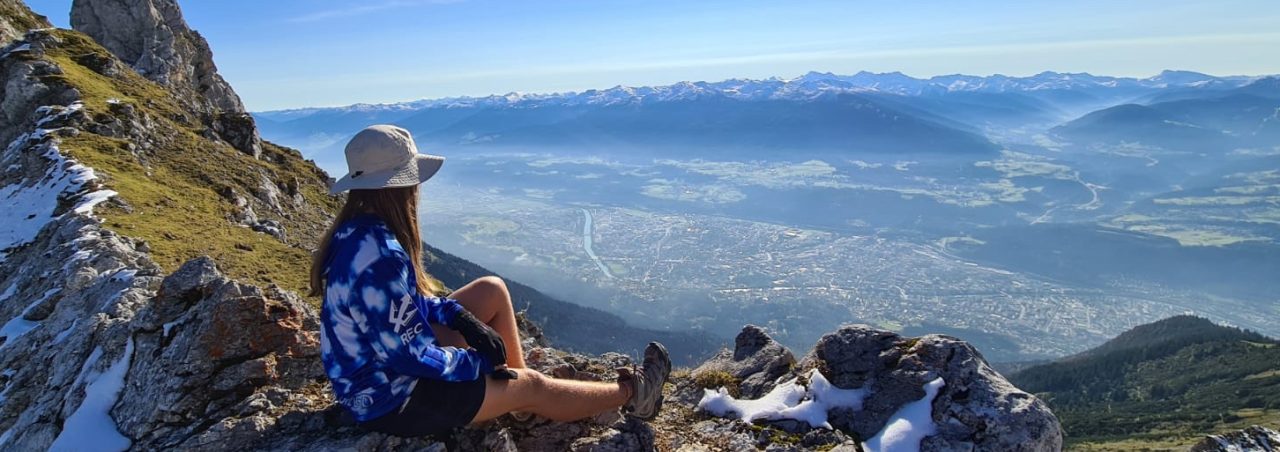
I have a good friend who I go hiking with every few weekends. She knows all the local mountains like the back of her hand, so she always has an idea where to take me. Last year we went snow hiking and she loaned me her snowshoes!
I will really miss my students! But that will happen regardless of when I leave.
Great opportunities keep appearing. The longer I stay, the better relationships I make at school and outside of school. For example, I play soccer with a university professor who asked me to help him lead a discussion about gender equality, and another professor friend asked me if she could use my writing in her classes.
In the past few years, my tendency has been to bounce around from place to place. After college, I spend a year in New Zealand, a year in Australia, and about 8 months traveling in Southeast Asia (three months in Thailand, three weeks in Cambodia, three weeks in Vietnam, three weeks in Taiwan, a month in Bali, a month in Malaysia, and three months in the Philippines. I paid for my trip by volunteering and working along the way.) Maybe I should break my habits and commit to a place for a bit longer, and see if I can make a bigger difference.
I can save money here (although my dad said ‘You’re life is worth more than money.’)
This is from the ALT Christmas Party! We did a White Elephant gift exchange.
I spend my weekends playing futsal (indoor soccer)!
Reasons to leave
I know I’m capable of more than this. In class, oftentimes I’m just used as a tape recorder, doing ‘repeat after me.’ It’s kind of fun, but its not really helping me grow as a teacher. (Although recently I’ve had the chance to teach the whole class a few times, but without much warning. My school is pretty disorganized when it comes to dealing with the ALT.)
I’m frustrated by the school system. I want more opportunities to teach the class and lead communication activities. Students really need it, too; even though most Japanese people have studied English for 6 years – 3 in Junior High and 3 in High School – the vast majority of Japanese people I’ve met in my community have no confidence to speak English.
People here are devastatingly shy. My outgoing and friendly personality doesn’t fit with the reserved and soft-spoken tendencies of Japanese people. Even if I learn Japanese, I feel a thick layer of ‘tatemae’ (politeness, pleasantries) in between me and the locals. Of course, there are many exceptions to this, and I tend to make friends who don’t fit these societal stereotypes.
Staying is the easy and safe thing to do, and I’m usually one to challenge what is safe and easy. I’m an ambitious person with a lot of energy, and I don’t want to waste it. I don’t want to stay just because it’s easy.
If I stay at my ALT job, I’m just procrastinating my future.
I have so many things I want to do in my life!!! My bucket list is long! For example:
Study Spanish and teach English in South America, maybe Argentina or Chile. Spanish is a language that I can use when I move back to California in the distant future. This is the plan I’m most excited about, but it requires a lot of research and preparation.
Travel across Europe visiting friends, hiking, and volunteering on farms.
Live on an Ashram in India and study yoga and meditation.
Become a teacher in America to give back to my own country which gave me so much. I think this is what I’ll do after I live abroad for 5 or so more years. I do want to live near my family in California someday.
I’ll really miss the sushi when I leave!
4:31, 12/20
Now its Monday, and I just fought through a pretty boring day at work. The interesting teacher Mr. Imajo* wasn’t here today, so in the classes I joined I was pretty much just a tape recorder. After a day like today, I’m thinking I’ll leave next summer. Here’s my rough idea for next year. (Although I have to check the exact dates with my school):
January – Japan, work
February – Japan, work
March – Japan (spring break is 3/25 to 4/4)
April – Japan school year finishes. My sister’s wedding is April 22. Cherry blossoms!
May – Japan, new school year starts
June – Japan, work, sell my stuff
July – Japan, work, summer break starts mid July, move out of my apartment
August – Japan, summer break, travel, free ticket to CA (although I might not use it)
September – Travel in Spain with my dad
October -Spain (teach English?)
November – Spain (teach English?)
December – California for Christmas
January – ???
Thanks for reading! Let me know if you have any ideas or feedback.
Fall is drawing to a close. The days are getting shorter, and the nights are getting colder. Winter is settling in, and it’s time for me to reflect on my teaching and life in Japan. As always, there have been highs and lows, and today I’ll share a few of each.
Fall in Japan is famous for “kouyou”, or colorful autumn leaves.
Joining Art Classes
On a crisp fall morning, I drove on a winding misty mountain road to my small visiting school. Every Wednesday I visit this secluded community. There are 40 students in the whole school, so there are only 11 to 15 students in each class. They grow watermelons in a small farm plot next to their school.
After I scrutinized the schedule, I realized that that my three English classes were fourth, fifth, and sixth period. My supervisor told me we were doing interview tests, and I already had the questions ready. So since I had the first three classes free, I decided to join a class! With my kanji cheat-sheet, I can look at the daily schedule and decipher when my favorite Art (美術) PE (体育) and Music (音楽) classes are.
Before first period, I peeked into the art room and found the grandfatherly art teacher preparing some materials. Gathering my やる気 (‘yaruki’, or willpower), I said, “Ishyoni daijyobu desuka?” I was trying to ask if I could join the class… I hope I didn’t say anything rude. Apparently my sentiment was clear, and he said okay. (It’s not the first time I joined; last time we made sculptures!) Today was pencil drawings.
One student in that class is super enthusiastic about speaking English, so I sat next to him. He was trying to draw a picture of himself at a track-and-field meet jumping over a hurdle. It was hilarious to listen to him express his frustration in Japanglish about not being able to depict himself the way he wanted. He kept erasing furiously and blurting things like, “Oh! This leg! Wrong! Oh no!” for my listening pleasure.
When I join these kinds of classes, I always walk around the room and talk to each student about what they are drawing. I try to make it an easy, simple, low-stress conversation, and I hope each student can achieve one of those elusive but rewarding “I Can Speak English” feelings. Even if all they said is, “Dog,” they still communicated something, and I know it’s good for their confidence. Oftentimes I feel like my presence alone is enough to change the atmosphere, and I notice more people around my trying to use English. (On the other hand, sometimes I feel completely ignored and invisible when I can barely understand anything and no one makes any effort to communicate or translate for me.)
Even the lowest level student in that class, who scores only 20 or 30 points on tests where most of his classmates are in the 80 and 90 range, has been opening up to me. He also happens to be a very talented artist, and I try to compliment him as much as possible. At the beginning of last year, he used to avoid eye contact. Now, when he sees me, he greets me with a big “Hello!” and a smile.
Since I am maybe one of the only foreigners they will ever meet (at least in this part of their lives), I want to equate my presence with something more than just a language barrier. I hope some of them remember their interactions with me, not only in English class but also in other settings, and can make positive associations with all of us space aliens.
Temples in Japan are tranquil places. This one is only 5 minutes from my base school.
Olympic Athletes Visit My School
Today, two professional Japanese athletes – an Olympic table tennis player and a professional soccer player – gave a special lesson about goal setting to my students at my small visiting school. I didn’t have class at that time so I was invited to observe the activities. The warm up activity was trying to return a serve by the table tennis star. About half the students play table tennis every day after school, so most of them could do it! For the next 50 minutes, students competed against the adults in games like dodgeball and tag. (I wanted to participate but I was invited to observe only. I wish I could have joined the games though.)
After that class, I approached the athletes and asked, “Zenbu no chugakkou ikimasuka?” (Are you going to all Junior High Schools? I wanted to know if I could see them at my other school.) To be honest, I just wanted to start a conversation because I was curious to see if they spoke English. Lucky for me, one of them did! The soccer player asked me where I was from, and told me he learned English so he could play soccer abroad.
In the next class, the table tennis player told the students his life story. I could only pick up bits and pieces, but I’m pretty sure he moved to China when he was 8 and back to Japan when he was 13, and the overall message was that he had to work really hard and made a lot of mistakes but finally he was able to achieve his dream. Then, students brainstormed about their own dreams, and two students shared their ideas in front of the class. One boy said, “I want to be a pet trimmer!” Another said something like, “I don’t know my dream, but I’m going to search hard!”
After everyone bowed a few dozen times and thanked each other profusely, the athletes were heading out the door. I knew I only had a few seconds to make sure the kids heard my new friend speaking English. So I rushed over to him and asked, “Hey, can you tell the kids that you can speak English?” He was a little surprised, but he repeated what he told me for students – “I played soccer in 13 countries, and you should study English so you can travel!”
At the end of the day, I was proud that I had gotten in a plug for English. I hope these students realize that learning English will open a lot of doors for them.
Feeling Grateful for my Childhood
Of course it’s nice to share the highlights of my experience in Japan, but I don’t want to make it seem like everything is perfect. Sometimes I am so frustrated and annoyed at school, I’m so bored and I feel like my talent and time is being wasted, and I wonder why I came all this way to be ignored and not utilized. Many ALTs face these feelings of idleness, especially during test weeks (which happen about once a month, it seems.) The secret is to channel my energy into something productive, instead of dwelling on these feelings.
Something I’ve noticed is that there’s quite a difference in discipline in Japanese schools. I have heard some teachers yelling – really screaming at the top of their lungs – at students more than once, and it makes my blood boil. It reminds me to be thankful for my childhood. I don’t recall any teacher ever yelling at me. I grew into a confident and successful person, partly because many people showered me with praise when I was growing up – my parents, teachers, grandparents, sister, and friends… I received very little negativity as a child, and I think this contributed to my success.
A few weeks ago, I went to a cafe to meet a friend, and when I was leaving the woman at the cash register asked me where I was from. The conversation continued, and we realized that her daughter goes to my school. Her daughter is a nice girl who talks to me quite often, and who has really opened up to me, and I actually remember her name. (I think I know about a third of my students names.) I told her mother that I thought her daughter was smart, and her mother promptly responded, “Oh no, my daughter isn’t smart. She’s quite fat, too.”
I had to quickly say goodbye because I was so shocked and angry by what she had said. Why would any mother say this about her daughter? Why would she tell a complete stranger that? If someone had told me that when I was 13, who knows where I’d be today!
I’ve lived in Japan for about a year and a half, and I still am a total outsider to this culture. I can’t understand why a mother would say that about her daughter. I can’t understand why a teacher would scream so angrily at a room of scared 11-year-olds. Of course, my observations of these few instances are in no way representative of all teachers and parents in Japan. But I’m still shocked and appalled when I witness situations like this, and I want to understand why they occur. If anyone reading this has any clues, please enlighten me.
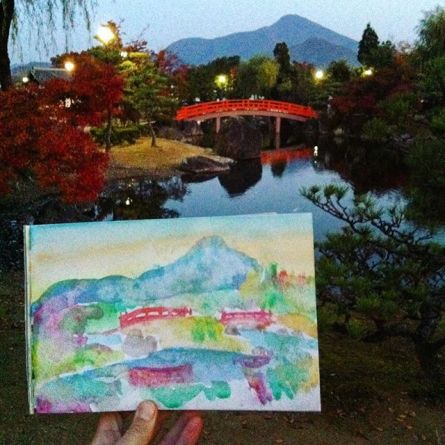
I did this watercolor painting at a park near my house.
The Ichi-Nensei Students at my Visiting School
For me, perhaps the best thing about being a teacher is seeing my students change. In particular, I remember the first time I met my ichi-nensei students (equivalent of US 7th graders) at my visiting school. When they first saw me last August, they looked at me like I was a space alien. Then they started speaking to me in Japanese, and I told them honestly that I couldn’t understand them. I think they were shocked to realize that there are genuinely people in the world who don’t speak their language. Maybe they had seen foreigners on TV or had met one a few times at their tiny elementary school, but I think I’m the first foreigner they get to see on a regular basis.
A turning point was when I ran into one of them outside of school. I joined an all-girls Japanese soccer team, and we have our practices on Thursday nights. Miraculously, my team shares a field with a junior high school team – and three of my students are on that team! I was so excited to see them there every week, and they must have been surprised to see me, too. They taught my name to their teammates, and sometimes when I did my warm-up lap around the field, I’d be greeted with a chorus: “Oh, hallo, An-bah!!”
Now, I had something new to talk to them about at school – “Oh, I saw you on Thursday! How was practice?” One student even said to me the next day, “I liked your green socks yesterday.” A student from the smaller school told his teacher and all his classmates about it, so suddenly the whole school knew where I was on Thursday nights.
Lucky for me, this soccer player is one of the leaders of his class because he is loud and fearless. When I first brought my ukulele to his class, he brashly approached me and demanded that I give it to him. My instincts didn’t warn me that he was going to smash it, so I handed it over – and to the classes amusement, he tried to strum a tune. Ever since that first interaction, with his peers watching, a few other students have approached me and asked me to teach them the ukulele, too. Every week they want to learn more!
Fast forward to now. They’ve been seeing me once a week for about 4 months, and now they approach me in the halls willingly! Some of them are still scared of me, but a few of them have really started to be friendly and ask me questions, especially about Donald Trump or the Pen Pineapple Song. (Beware, it’s obnoxious but obscenely popular.)
I’m honored to watch their transformation. They motivate me to come to school early so I can talk with them more. I hope that I can see them again in 10 years, and that they will be thriving in whatever they choose to do.








 Where Is Amber?